The Data of Royal Eating
This digital resource brings together the daily food allocations from two substantial kitchen ledgers from the palaces of King George III and his son, the future George IV, between 1788 and 1813. These "bills of fare" contain more than 3,000 unique dish constructions and more than 40,000 served dishes.
Each dish has been classified by a number of categories related to cooking—from details of key ingredients to cooking method—resulting in over 1.3 million points of scholarly data about daily eating in Georgian Britain.
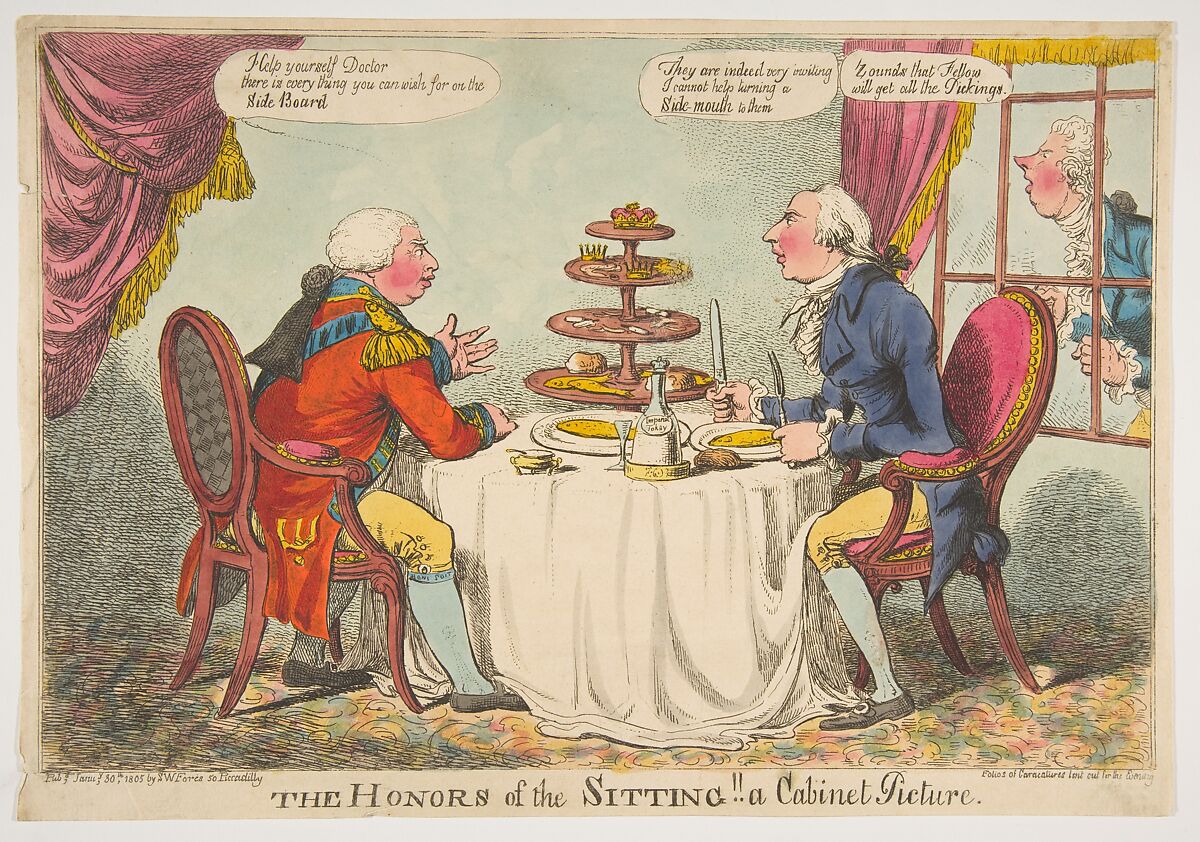
The Two Georges
The ledgers provide insight into the daily reality of the royal family, including the extent of the Prince Regent's gluttony and the King's and Queen's frugality. When it came to food, the two Georges were imagined very differently by contemporaries.
King George III (1738–1820)
George III reigned for sixty years (1760–1820) and was known for his modest tastes. Contemporary caricatures, such as James Gillray's Temperance enjoying a Frugal Meal, depicted him and Queen Charlotte dining on simple fare like eggs and salad. The Kew Ledger confirms this image: eggs and spinach was their forty-sixth most commonly received dish, appearing twenty-eight times.
The King's political position was complicated in 1788 when his mental illness caused the Regency Crisis, leading Parliament to debate his fitness to rule. During these periods, he was more easily hidden from public view at the remote Kew Palace, where the ledger provides a unique window into both his everyday meals and the "sick dish cookery" prescribed during his illness.
The Prince Regent (1762–1830)
George IV, as Prince Regent (1811–1820) and later King (1820–1830), was notoriously gluttonous and known for his elaborate preparations at the dinner table. Gillray's A Voluptuary under the Horrors of Digestion shows him as a man obsessed with excess food and drink.
The Carlton House ledger confirms his lavish tastes: a well-stocked and very meaty sideboard at every meal, a wider array of alcohol, and a penchant for creamy dishes and elaborate desserts to a degree not seen at Kew.
The Ledgers
The Kew Ledger (1788–1801)
Held at The National Archives, this volume details the food served daily at Kew Palace, the occasional and convalescent home of King George III to the west of London (no longer standing). Across this period, the kitchen at Kew was active on 410 unique days, serving 22,655 dishes to more than fifty distinct groups of eaters.
The Carlton House Ledger (1812–1813)
Part of the Royal Collection, this volume details the food served at Carlton House, one of the Prince Regent's properties on Pall Mall in London (now destroyed). In that year, the Prince's cooks served 17,703 dishes to more than forty distinct groups, with nearly half of all dishes destined for the Prince's own table.
Historical Context
The late eighteenth and early nineteenth centuries were a period of rapid imperial expansion, increasing commercialisation, travel, and migration. The ledgers point to the diversity of the diet available to wealthy households, the growing "Frenchification" of food, and the role of ethnicity and migration in shaping British cuisine.
British cuisine was born of a mixture of local ingredients, French methods, and components from across the world. Along with spices, other foreign ingredients also arrived: coffee, chocolate, and tea, transforming the drinking and socialising habits of the nation. All of these flavours appeared on the tables of the Royal family.
"If you are what you eat, then King George III and his household were mostly beef, with significant pockets of pudding, some little bits of lark, a generous helping of crayfish, and a healthy portion of vegetables."
Acknowledgement
This website provides an interface for exploring the dataset published by the original researchers. The dataset is released under a Creative Commons Attribution 4.0 (CC-BY 4.0) license and is available for download and reuse. If you use this data in your research, please cite:
Adam Crymble; Sarah Fox; Rachel Rich; Lisa Smith, 'Three Thousand Dishes on a Georgian Table: The Data of Royal Eating in England, 1788-1813', Food & History, vol. 21, no. 2 (2023).
This website is not affiliated with the original researchers or their institutions. It was created independently to provide an interactive way to explore their openly published dataset.
Further Reading
- Bickham, T. (2020). Eating the Empire. London.
- Hadlow, J. (2014). The Strangest Family: The Private Lives of George III, Queen Charlotte and the Hanoverians. London.
- Mennell, S. (1996). All Manners of Food: Eating and Taste in England and France from the Middle Ages to the Present. Chicago.
- Rappaport, E. (2017). A Thirst for Empire. Princeton.
- Food Timeline — Comprehensive encyclopedic resource on food history from ancient times to the present.
Quick Facts
- Time Period: 1788–1813
- Total Dishes: 40,358
- Unique Dishes: 3,247
- Data Points: 1.3 million
- Source Volumes: 2
Archives
The original manuscripts are held at:
- The National Archives (Kew Ledger)
- Royal Collection Trust (Carlton House Ledger)